Fewer vehicles are entering the repair stream. The ones that do are worth more per file, and more of them are getting totaled than at any point the industry has measured. For a hail shop, that means the document you write is doing more work than it used to, and the cars sitting closest to the line are the ones where thin writing costs the most.
The short version
- CCC's 2026 Crash Course put total loss frequency at 23.1 percent of claims, a new industry high.
- The car parc is older. There are 12 million fewer vehicles six years old or newer on the road than there were in 2020, which drops actual cash value across the board and pulls the total loss threshold closer on every borderline vehicle.
- Hail dollars are concentrating. State Farm paid 1.4 billion dollars in Texas hail claims in 2025, more than 27 percent above the prior year, and Texas led the country for the eleventh straight year.
- On a hail file, nothing is structural. Repair versus total is decided by a sum, which means it is decided by how the estimate was written.
- The correct response is not to write thinner to save the job. It is to capture options and condition at the vehicle so the value side of the equation is right, and to write the repair the vehicle actually requires.
What the data actually says
CCC Intelligent Solutions released Crash Course 2026 in March under the title "Complexity Compounds." Three numbers out of it matter to a shop that writes hail.
Total loss frequency reached 23.1 percent of claims. That is a record. Roughly one in four claims now ends with a check instead of a repair.
28.3 percent of repairable estimates now include a calibration. More on that below, because most people still file that under collision work.
There are 12 million fewer vehicles six years old or newer in operation as of Q3 2025 than in 2020. This is the one that gets the least attention and does the most damage to a hail file. Older fleet, lower values, lower thresholds.
CCC also found that higher deductibles are making smaller claims discretionary. People are eating the small ones. What reaches a shop is the heavier end of the distribution.
On the hail side specifically, State Farm reported paying more than 5.6 billion dollars in hail claims nationally in 2025, with 1.4 billion of that in Texas. Texas payouts were up more than 27 percent year over year. Texas recorded 902 major hail events in 2025. Illinois, in second place, recorded 375.
So the picture is two things happening at once. Hail dollars are getting more concentrated in a handful of states, and the vehicles catching that hail are worth less than they were five years ago.
Why this lands harder on hail than it does on collision
A collision car tells you something about itself. Structural damage, deployed restraints, a rail that is bent. There is usually a physical fact somewhere in the vehicle that says this one is done.
A hail car has none of that. Every panel has damage and no panel is destroyed. There is no moment standing at the vehicle where anybody says out loud that this car is finished. It is a sum. Ten panels, some trim, some glass, and the number lands wherever the writing puts it.
On a hail car, the estimate decides repair versus total more often than the damage does.
That is not a comfortable sentence and I am not going to soften it. On a 2013 sedan with hail on every panel, two competent estimators can produce numbers that fall on opposite sides of the threshold. Neither of them lied. One of them wrote the damage and the other wrote the repair, and the second one included access, recoverables, adjacent panel repair, and the operations that the repair itself makes necessary.
I have written about that gap before. On the files I have compared, it runs into the thousands.
The part nobody wants to say: a complete file can total the car
If you write everything the repair requires and the number lands above the threshold, the vehicle is a total loss. That is the correct outcome. It means repairing that car costs more than the car is worth, which is a real fact about the car and not a mistake in your document.
The wrong response is to trim the file to keep the job in the building. Writing a hail car thin to avoid a total accomplishes exactly one thing: the shop performs unpaid work on a vehicle that should have been settled.
The right response is to make sure the other side of the equation is right, and that is the part that gets skipped.
Capture options and condition at the vehicle — on every car
Including the ones that look nowhere near the line.
Third row. Leather. Navigation. Trim level. Tow package. Drivetrain. Wheels. Mileage. Tire condition. Prior damage. Prior repair. Aftermarket panels already on the car.
Actual cash value is what sets the threshold. Options and condition are what set actual cash value. If the carrier's valuation comes back low and you never recorded what was on that car, you have nothing to say. The vehicle is gone, the customer is home, and you are arguing about a trim level from memory.
It takes seconds at the car. It is impossible once the car leaves.
And when a valuation dispute does turn into a fight, the remedy has a price of admission that most people never get told about. I wrote about that here: the right to appraisal is guaranteed, but access to it is not.
Calibrations are now a hail conversation
Twenty eight percent of repairable estimates carry a calibration. Most hail estimators still think of calibration as a collision problem. It is not, and it has not been for a while.
Where it shows up on a hail file:
- Windshield out for roof access, which is standard on a lot of roof repairs and every roof replacement. Forward facing camera comes with it.
- Back glass out on a hatch or a roof.
- Blind spot modules living behind quarter panels.
- Mirror assemblies with cameras in them, and mirror caps get hit constantly.
- Any roof replacement on a vehicle with a roof mounted sensor or antenna module.
If the glass comes out, find out what is attached to it and what the manufacturer requires afterward. Then write it, with the procedure referenced on the line note. That is a mechanical labor line and a sublet line on a lot of files, and it disappears from hail estimates constantly because the person writing it came up in hail and never had to think about it.
Send one vehicle. I write it inside your CCC ONE or Mitchell account, under your shop name, every operation line noted, and I defend it with the appraiser.
I-CAR published an equipment standard, which is really a lighting argument
On July 2, I-CAR published its Automotive Collision Repair Facility and Equipment Best Practice, built with OEM, insurer, and repairer input. The point of it is to set a common expectation for what equipment a facility needs to perform a complete and safe repair.
That is the same argument hail has been having with itself for twenty years, just formalized.
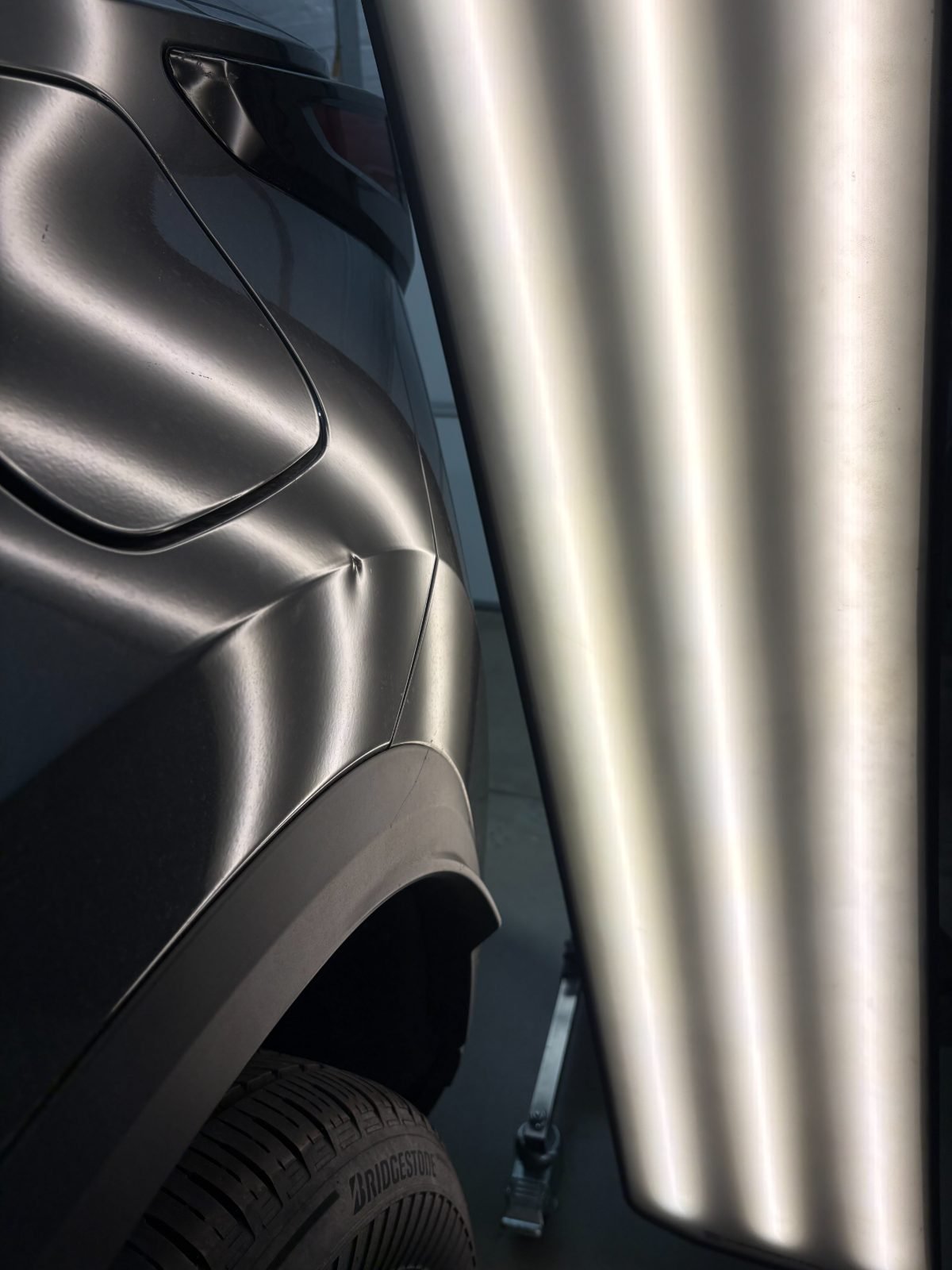
Here is the version that matters to you. I wrote a car in a parking lot on an overcast Tuesday morning, which by outdoor standards is as good as it gets. I called the hood around forty. Two days later the same car came into a bay with a PDR light and everything else in the building off. The hood was over ninety. The roof went from about sixty to past a hundred and thirty.
Nobody added dents to that car overnight. They were there the entire time while I stood over them counting, and the appraiser standing next to me could not see them either. It is not a competence problem. It is a physics problem. An overcast sky is a huge, soft, edgeless light source, and you are not looking for dents. You are looking for a straight reflected line that stops being straight. An overcast sky does not put a line on the panel, so there is nothing for a dent to bend.
Moving a hood one count band changes what that panel pays. Moving it two bands changes it considerably more, and now you are explaining a large correction to somebody who was standing there when you wrote the small one.
When total loss frequency is at a record and thresholds are closer than they used to be, a count that is off by half is not just a supplement. It is the difference between a settlement and a repair, in either direction.
The hierarchy, stated plainly
- Optimal. A bay, a PDR light, ambient and indirect light controlled or eliminated.
- Workable. A shop with the lights on. Not ideal, but a controlled environment and a proper light in your hand.
- Making the best of a bad situation. Outdoors with a dent shade, in shade or overcast.
- Not an inspection. Outdoors with nothing but your eyes. A wet panel. A dirty panel.
You will still read in older training material that overcast conditions are ideal. They are not ideal. They are what you do when you do not have a building.
The borderline car checklist
Use this on any hail vehicle where the number might land near the threshold, which in the current fleet is more cars than you think.
At the vehicle
- Photograph the VIN plate, the jamb label, the paint code, and the odometer. Photograph, do not transcribe.
- Record every option that carries value. Trim, third row, leather, navigation, drivetrain, tow package, wheels.
- Photograph prior damage and prior repair before you do anything else, not at the end.
- Note anything you could not open or could not position properly.
- Note the inspection conditions. Where you scoped it determines what you can defend.
On the file
- Write the repair, not the damage.
- Run a separate recoverables pass after the writing pass. The writing pass will not catch them. Seam sealer material, weld through primer material, feather prime and block, and cover car as three operations rather than one.
- Check every refinish addition for access. Refinish hours move twice, because materials calculate off them.
- Write the repairs the repair itself makes necessary. Pull a roof and the bows and rail edges are part of the job.
- Check what comes out with the glass and what the manufacturer requires afterward.
- Line note every operation that a stranger would question.
When it goes total anyway
- Send the valuation options list you captured.
- Confirm the customer knows what was and was not included in the valuation.
- Keep the file. A settled total with a complete file is a much shorter conversation than a settled total with a thin one.
What this adds up to
Fewer cars, higher stakes per car, and a fleet that totals more easily than it did. None of that is fixable from a shop. What is fixable is the quality of the document that decides which side of the line a vehicle lands on, and whether the shop gets paid for the work it is going to perform either way.
That is entirely a writing problem, and writing problems have solutions.
Frequently asked questions
What is the total loss threshold for a hail damaged vehicle?
The threshold is a percentage of the vehicle's actual cash value, and it is set by state law or carrier policy depending on where you are. It commonly falls between 70 and 80 percent. When the repair cost plus any applicable fees exceeds that percentage of ACV, the carrier settles the vehicle as a total loss rather than repairing it.
Can a hail damaged car be totaled even if it drives fine?
Yes. Hail damage is cosmetic in most cases and the vehicle remains fully operable. Total loss is an economic determination, not a safety determination. If the cost to restore the vehicle to pre loss condition exceeds the threshold percentage of its value, it is a total loss regardless of whether it drives.
Should an estimator write a hail file thinner to avoid a total loss?
No. The estimate is a description of the repair the vehicle requires. Reducing it to keep a job in the building means the shop performs work it will not be paid for, on a vehicle that should have been settled. The correct action is to document options and condition thoroughly so the valuation side is accurate.
Why do two estimators write the same hail car thousands of dollars apart?
Almost always because one wrote the visible damage and the other wrote the full repair. The gap sits in access operations required to reach the damage, recoverable materials that are not included in the labor premise, adjacent panel repair caused by the repair itself, and refinish operations that carry materials with them.
Do hail repairs require ADAS calibration?
Frequently, yes. Any hail repair that removes a windshield, back glass, mirror assembly, or roof panel can disturb a camera, radar unit, or sensor module. Calibration requirements come from the manufacturer's repair procedure for that specific vehicle, and the operation belongs on the estimate when the procedure calls for it.
Is overcast light good enough to scope hail damage?
No. An overcast sky is a large, soft, edgeless light source that produces no defined reflection on a panel, and a dent is only visible when it distorts a defined reflected line. A controlled bay with a PDR light is the standard. Outdoor inspection with a dent shade is a compromise, and outdoor inspection without one is not a reliable inspection.
About the author
Chris Johnson is the founder of Storm Rider Solutions and a co founder of Extreme Hail and Collision in Plano, Texas. He has been in collision repair since 2008: service writer, estimator, production manager, assistant manager, lead estimator at United Hail Pros and then Metal Majic, director of hail and collision operations at Metal Majic, and director of estimatics at Westway Collision. He has been writing hail specifically since 2021, and provides training, consulting and remote estimating for Dents Or Us and Hail Pros LLC. In the last 45 days he has written $1.6 million in added value across 114 vehicles for two hail operations. He is a United States Marine Corps veteran.
About Storm Rider Solutions
Storm Rider Solutions writes remote hail and collision estimates and supplements for PDR and collision shops, inside your CCC ONE or Mitchell account, under your shop name. Every operation is line noted, and I defend the file with the appraiser on your behalf. It is overflow support for shops whose estimators are buried, not a replacement for them.